News
For thirty years, Legal Netlink Alliance has served the needs of clients worldwide.
Read the full legal update:
By Márcio Henrique and Rosendo Vieira
21 October 2026
On 16 October 2026, Brazil's National Congress promulgated Constitutional Amendment No. 141, arising from the approved text of Proposed Constitutional Amendment (PEC) No. 221/2019.
The amendment progressively reduces the maximum working week from 44 to 40 hours and establishes two days of paid weekly rest, without any reduction in remuneration.
For companies and management teams, these changes affect work schedules, payroll administration and collective bargaining.
Below, we explain what changes, when the changes take effect and which matters remain subject to further clarification.
The amendment was published in the Federal Official Gazette (Diário Oficial da União) on 16 October 2026, and most of its provisions entered into force on the date of publication.
However, the introduction of two days of paid weekly rest and the reduction in weekly working hours are subject to a transitional period.
The reduction in the maximum working week will take place progressively. The first stage begins two months after publication, on 16 December 2026, when the weekly limit will fall from 44 to 42 hours. The requirement to provide two days of weekly rest must also be implemented within this period.
One year after the completion of this first stage, on 16 December 2027, the maximum working week will reach its final limit of 40 hours, while the maximum daily working time of eight hours will remain unchanged.
During the initial two-month period, the existing limit of 44 working hours per week remains applicable.
The new item XV of Article 7 of the Federal Constitution provides for two days of paid weekly rest, one of which should preferably fall on a Sunday.
Although the amendment does not expressly use the term "6×1 work schedule" (six working days followed by one rest day), its practical effect is clear: once this provision takes effect on 16 December 2026, schedules providing only one day of weekly rest will no longer be permitted as a general rule.
An exception is established under Article 7, paragraph 2.
In exceptional circumstances, a collective bargaining agreement may establish a compensatory working-time arrangement that guarantees an average of two days of paid weekly rest within a calendar month, provided that at least one rest day is taken within each working week.
In practical terms, a collective bargaining agreement — whether a sector-wide collective agreement (Convenção Coletiva de Trabalho) or a company-level collective agreement (Acordo Coletivo de Trabalho) — may provide for one rest day in one week and three in the following week, provided that the monthly average amounts to two rest days per week.
What paragraph 2 does not permit is an entire working week without any rest day, since the requirement for at least one rest day per working week remains applicable.
In other words, the maximum period of consecutive working days remains approximately six days.
As explained above, the reduction to a 40-hour working week is not immediate.
Two months after publication, the maximum weekly working time will decrease to 42 hours. One year later, it will fall to 40 hours.
The eight-hour daily limit remains in place. However, during the transitional period in which the 42-hour weekly limit applies, a collective bargaining agreement may authorise an extension of daily working hours to enable the redistribution of weekly working time, provided that rest requirements are respected.
Employees whose contractual working week is already 40 hours or less will not be entitled to a proportional reduction in their working hours. Nevertheless, the requirement to provide two days of weekly rest will also apply to them.
The reduction in working hours and the increase in weekly rest apply to existing employment contracts and may not result in any reduction in remuneration, whether nominal, proportional or otherwise.
This protection also extends to minimum wage rates established for the relevant occupational categories.
However, a contentious issue arises in determining the applicable hourly rate.
Constitutional Amendment No. 141 does not specify the divisor to be used when calculating hourly remuneration.
An employee's monthly salary does not, in itself, determine the hourly rate. To calculate that rate, the remuneration included in the relevant calculation base must be divided by the divisor applicable to the employee's working-time arrangement.
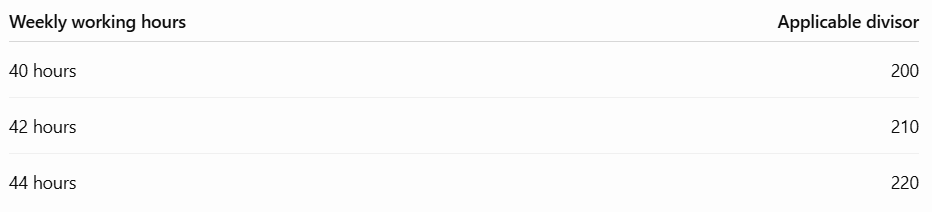
Under the traditional 6×1 schedule, involving a 44-hour working week, the divisor generally applied was 220.
For employees subject to the general working-time regime who work 40 hours per week, Precedent No. 431 (Súmula 431) of the Superior Labour Court (Tribunal Superior do Trabalho, TST) established a divisor of 200.
However, the calculation of these divisors was based on a working-time arrangement providing one weekly rest day.
The calculation was performed by dividing weekly working hours by six and multiplying the result by 30.
For a 44-hour working week, this produces a daily working time of seven hours and 20 minutes, which, multiplied by 30 days, results in a divisor of 220.
The same methodology was applied to a 40-hour working week, producing a divisor of 200:
(40 hours ÷ 6 days) × 30 days = 200.
Applying the same formula to a 5×2 schedule — five working days followed by two rest days — would produce a higher divisor and, consequently, a lower hourly rate.
For a 42-hour working week:
(42 hours ÷ 5 days) × 30 days = 252.
For a 40-hour working week:
(40 hours ÷ 5 days) × 30 days = 240.
As demonstrated, applying this methodology would reduce the calculated hourly rate because the divisor increases.
The amendment's failure to address this issue creates legal uncertainty.
As a precaution, given that Constitutional Amendment No. 141 expressly prohibits any reduction in remuneration, whether nominal, proportional or otherwise, the advisable approach — to minimise potential employment-related liabilities — is to follow the methodology already established by the Superior Labour Court under Precedent No. 431 and Theme 260 of its Repetitive Appeals Incident (Incidente de Recursos Repetitivos, IRR):
Once the new rules enter into force, provisions of collective bargaining agreements that conflict with the new constitutional limits will cease to be valid.
However, provisions establishing more favourable conditions for employees will remain effective.
Collective bargaining therefore assumes a central role.
It is through collective bargaining agreements that employers and employees may establish the compensatory arrangements permitted under Article 7, paragraph 2, and authorise extensions of daily working hours during the transitional 42-hour working-week period.
Item XIV of Article 7, which establishes a six-hour working day for employees working continuous rotating shifts, except where otherwise agreed through collective bargaining, has not been amended.
Article 7, paragraph 3, of the Federal Constitution goes further by providing that legislation may establish specific circumstances and conditions for differentiated working-time and rest arrangements, subject to the limits established under items XIII, XIV and XV.
Such implementing legislation has yet to be enacted.
The amendment establishes specific treatment for certain categories.
Employees holding a university degree and receiving monthly remuneration equal to or greater than 2.5 times the ceiling applicable under the General Social Security Regime (Regime Geral de Previdência Social, RGPS) — BRL 21,188.88 as at the date of publication of the amendment — are excluded from the rules governing working-time limits and working-time recording, unless the employer voluntarily applies those rules or they are provided for in a collective bargaining agreement.
Nevertheless, weekly rest requirements must still be observed.
This exception does not apply to public-sector employees.
For contracts with public administration bodies that were in force on 16 October 2026 and whose performance involves the direct employment of labour, the reduction in working hours will apply following a contractual amendment designed to preserve the contract's economic and financial equilibrium.
Such an amendment must be formalised within one year of publication of the constitutional amendment.
At the end of that period, the new working-time rules will apply to the employees concerned even if no contractual amendment has been executed, and the prohibition on reducing remuneration will remain applicable.
Contracts amended during the initial two-month period will follow the general implementation timetable.
For individual microentrepreneurs (Microempreendedores Individuais, MEIs), microenterprises and small businesses, supplementary legislation may introduce transitional measures, conditional upon the maintenance of employment levels.
The new rules apply to domestic workers in the ordinary course.
The first step is to review working hours and shift schedules across departments, identifying employees who currently work more than 40 hours per week or work six days per week, and assessing how shifts and staffing arrangements should be reorganised.
At the same time, companies should review the provisions of applicable collective bargaining agreements and initiate negotiations sufficiently in advance.
From an operational perspective, employers should:
Companies holding public-sector contracts should assess requests for contractual economic and financial rebalancing within the prescribed one-year period.
Given the recent nature of the changes, employers should also monitor implementing legislation, collective bargaining arrangements and judicial decisions.
As the new working-time framework becomes established, businesses and legal professionals will need to monitor several developments:
The Employment and Labour Law team at Moura Tavares Advogados will continue to monitor these developments and remains available to provide clients and business partners with guidance and clarification concerning the changes introduced by Constitutional Amendment No. 141, which reduces the working week to 40 hours and increases paid weekly rest to two days.
.png)
.jpg)
.jpg)